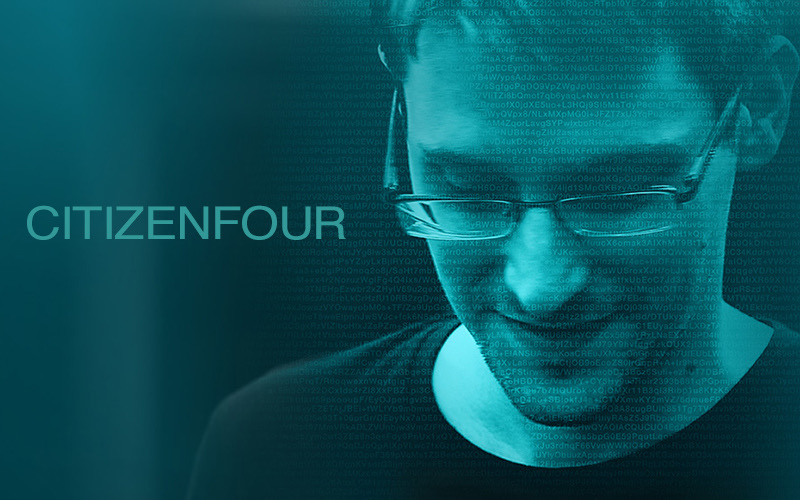
In the opening scenes of director Laura Poitras’s Citizenfour (US,2014.), the viewer is instantly drawn to one palpable conclusion; personal privacy in the modern age is a privilege, and it ultimately comes at a cost now more than ever before. Edward Snowden, most notably known for exposing US government surveillance secrets, is the key focus of this documentary. Snowden can arguably be viewed as the physical, human representation of the blurring of lines between the public and the private sphere. In giving up the intelligence gained while working for the CIA, and subsequently as a contractor for the NSA, Snowden’s private life is almost instantly eradicated, as shown halfway through the documentary.
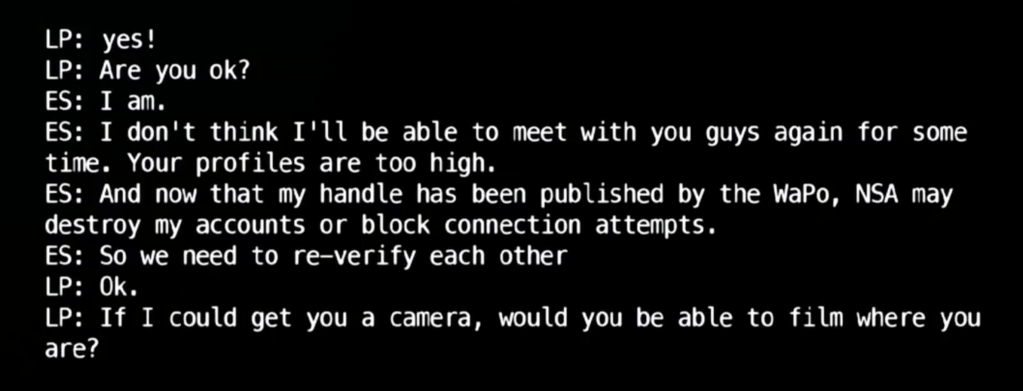
Poitras first portrays Snowden as a seemingly harmless, ordinary citizen. He is filmed casually, his manner and tone are in line with this approach to documentary filmmaking, and the viewer is given the impression that this subject is not going to alienate them from the topic at hand. This framing of Snowden is important for the overall theme of the documentary – that the ordinary person is incomparable to the major government organisations which, as revealed throughout the film, are constantly breaching the wall between what is freely public, and what is inherently private to the standard individual.
The documentary poses many questions to the viewer as to what is truly private, and what is truly public in the digital age. By using Snowden as a medium for questioning the boundaries of private and public, Poitras raises many pressing issues. For example, Snowden acts on a matter of moral principle. He relinquishes his own private sphere, merging it with the public in order to shed light on the ongoings of government bodies worldwide, who supposedly work with the public’s best interests in mind. In a recent interview conducted with Ewen McAskill and The Guardian, Snowden discusses his recently published memoir in which he speaks freely of his new life in Russia. This is highly interesting in contrast to the secrecy he was seemingly destined to live by upon the reveal of sensitive government documents years prior. In the interview he comments that he “doesn’t live that way anymore”.
It is evident through the course of this documentary that, to Snowden, privacy, and by extension the freedom to access sensitive information, is constantly under the pressure of individual choice. In one particular scene, for example, Snowden and the journalist Greenwald discuss the true power of a choice, and how that power can be felt across the world in an open manner. This concept is arguably an antithesis to Bauman’s theories of the public and private sphere.
Yes, the public and private spheres are constantly changing, but the question is raised here as to how do they change, and are they influenced by the choices society makes.
Snowden makes a personal choice to leak the classified government documents he is given access to. He chooses to reveal the truth to the public that in this lifetime, they will possibly be unable to truly live a tangibly private life. This documentary draws attention to the collective model of life society lives in now. One that is increasingly without the option of obtaining true anonymity or by default, the ability to maintain one’s own private life.
Bibliography
- Bauman, Zygmunt. “Is This the End of Anonymity?”. The Guardian, 28. June 2011,
https://www.theguardian.com/commentisfree/2011/jun/28/end-anonymity-technology-internet
- Papacharissi, Zizi. “The Virtual Sphere: The Internet as a Public Sphere”. New Media & Society, 4:1 (2002).

 Mallaigh Slattery Film Analysis Project